
Reviewed · COMMUNIST & YUGOSLAV HISTORY TOURS
Tito and History Vintage Car Tour
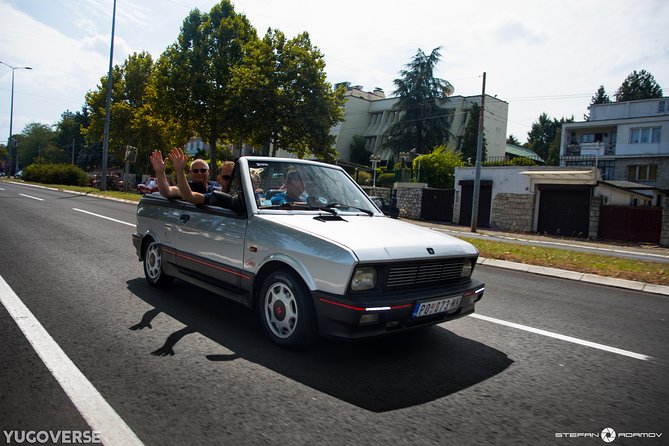
The most unusual part of this Belgrade tour is the car itself. You ride through the city in a vintage Yugoslavian vehicle while learning why the Yugo became famous as one of the world’s worst cars, and why that reputation does not tell the whole story. The tour also includes the rare topic of the Yugo convertible.
I like the private format, since your guide can spend time on the cars and the old Yugoslav system instead of rushing through a fixed script. I also like the route: Genex Tower and Palata Srbije show off socialist-era design, while the Museum of Yugoslavia gives the story a human and political center. The main consideration is price: at $144, this makes the most sense for a small group that values a specialized experience, not for someone seeking the cheapest way to see Belgrade.
Key points to know before booking
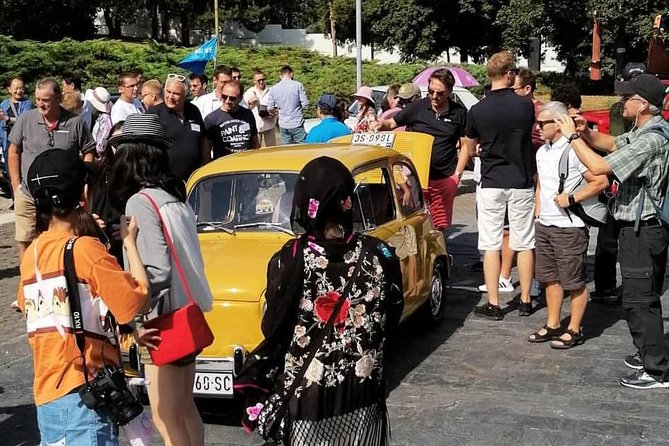
- Vintage cars are the main attraction: The Yugo, including its convertible version, is central to the tour rather than a minor extra.
- The route links major Yugoslav sites: You visit Friendship Park, Palata Srbije, Genex Tower, and the Museum of Yugoslavia.
- This is a private tour: Only your group takes part, which allows for a more personal pace and conversation.
- Pickup and refreshments are included: You can request pickup, and snacks and soda are provided along the way.
- Jovana has guided at least some departures: One especially positive account praised her passion and strong command of the subject.
- Allow two to three hours: The route combines several short outdoor stops with about 40 minutes at the museum.
Why an old Yugo is the perfect way to see this side of Belgrade
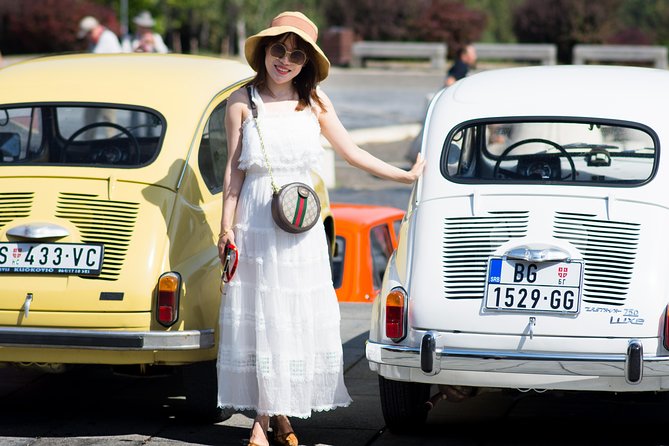
Belgrade is full of grand churches, riverside views, and lively streets. This tour takes a different route into the city’s 20th-century story, using old Yugoslavian cars as the thread that ties everything together.
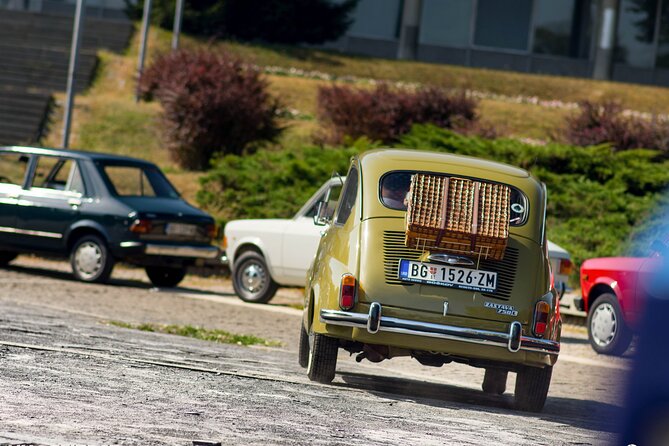
The Yugo is more than a joke about unreliable engineering. It was built in Yugoslavia and became one of the clearest symbols of everyday life under the socialist system. Its simple design, low price, and later reputation tell you something about industry, politics, and national pride. You will hear about those subjects while sitting in the sort of car that once appeared in ordinary family life.
That makes the experience more useful than a standard sightseeing drive. You are not simply being taken from one monument to another. The vehicle helps explain the period. The attention to the Yugo convertible is especially appealing because it adds an odd, less familiar detail to the story.
The private setup matters here. Only your group takes part, so you can ask about the car, Tito, Yugoslav design, or the difference between public symbols and daily life. The guide’s knowledge makes a real difference. Jovana is the guide named in the available feedback, and she was praised for being informed and genuinely passionate about the subject. Since guides can vary, you should confirm who will lead your departure if having Jovana matters to you.
More of the recent past in Belgrade:
- Belgrade Underground Tour w/ Sparkling Wine Along the River
★ 5.0 · 151 reviews - Belgrade War Island Kayak Tour
★ 5.0 · 101 reviews - Red Belgrade Communist Tour
★ 5.0 · 78 reviews
Starting at the National Assembly and the city center
The tour begins at Dragoslava Jovanovića 14 in central Belgrade, or you can request pickup. The first listed stop is the House of the National Assembly of the Republic of Serbia, with about 15 minutes to look around.
The building has a layered past. It was once the royal residence of the Obrenović dynasty and now houses the City Assembly of Belgrade. That change gives the stop a useful introduction to the way power shifted from monarchy to the socialist period and then to modern Serbia.
You should not expect a long interior visit here. Admission is free, but the stop is short and works mainly as an exterior orientation point. Your guide can place the building within Belgrade’s political center before the tour moves toward the larger Yugoslav-era sites.
This is also a good moment to settle into the unusual vehicle. A vintage car makes a short city-center stop feel more connected to the subject than a normal minibus would. You are looking at a government building while riding in an artifact of the same broad 20th-century story.
Friendship Park and the Non-Aligned world
Friendship Park, or Park Prijateljstva, is one of the most thoughtful stops on the route. Plan on about 20 minutes here, with no admission charge.
The park grew out of the Belgrade Conference in September 1961, the first summit of the Non-Aligned Movement. Its central feature is the Peace Alley, a 180-meter path lined by two rows of trees. Leaders from countries attending the summit planted the trees as a public symbol of peace.
The names connected with the park reach well beyond Yugoslavia. Queen Elizabeth II, Margaret Thatcher, Robert Mugabe, Jimmy Carter, Indira Gandhi, and Nicolae Ceaușescu are among those associated with the plantings. Members of the Rolling Stones also appear in the park’s unusual story.
The park is described as noble in concept but incomplete in execution. That tension is worth noticing. It reflects the hopes of a former country that wanted to play a major role between the Cold War blocs, as well as the hard limits and disappointments that followed.
Your guide’s explanation is important here because the park itself may not explain its political meaning in a clear way. You will get more from the stop if you listen for how Yugoslavia presented itself to the world. The visit is brief, so it will not satisfy anyone wanting a full political lecture, but it gives the tour a strong international frame.
Palata Srbije and the scale of socialist modernism
Palata Srbije is another short stop, lasting about 20 minutes. The building is presented as one of Belgrade’s most impressive modernist works, and it is a major reason this tour appeals to architecture fans as well as car enthusiasts.
The building’s size and formal design reflect the confidence of Yugoslavia’s federal government. Your guide explains its background and shows pictures of the interior, which is not open to the public. That detail matters: you can learn about the interior design, but you should not expect to walk inside.
The stop works best for visitors who enjoy buildings with a political purpose. Palata Srbije was not designed as a modest office block. Its scale was meant to express the importance of the federal state and the country’s place in the world.
Because the visit is outside and relatively short, your experience will depend on the guide’s explanation and your interest in modernist architecture. If your priority is grand old churches or medieval monuments, this may feel less rewarding. If you enjoy concrete, geometric forms, and buildings that reveal an era’s ambitions, it is one of the tour’s strongest moments.
A few more things to book in Belgrade
- History and Culture in my Belgrade
★ 5.0 · 41 reviews - NATO Bombing of Belgrade Historical Tour
★ 5.0 · 17 reviews - Football tour: Red Star and Partizan Ultras History
★ 5.0 · 14 reviews
Genex Tower, Belgrade’s brutalist landmark
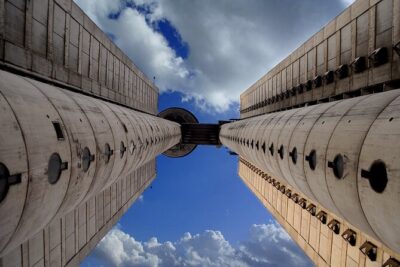
The Western City Gate, better known as Genex Tower, brings a sharper architectural edge to the route. It is a 36-story skyscraper built in the brutalist style and designed in 1977.
The structure is made of two towers joined by a two-story bridge. A revolving restaurant once crowned the top, adding a touch of spectacle to an otherwise severe design. The twin-tower form is easy to recognize, and the building remains one of Belgrade’s clearest examples of late Yugoslav modernism.
This is a stop for looking up. You will not be visiting a museum inside the tower, so the value lies in the exterior, the story, and the chance to see an important piece of city architecture without arranging a separate visit.
I like the way Genex Tower balances the softer, more diplomatic symbolism of Friendship Park. The park speaks about peace and cooperation. Genex Tower speaks through concrete, height, and industrial confidence. Together, they show two different ways Yugoslavia wanted to present itself.
The exact time at the Western City Gate is not specified, so the overall two to three-hour schedule may vary. If you want detailed photographs, ask your guide about the available time. A private tour gives you a better chance of pausing for pictures than a large shared group would.
The Museum of Yugoslavia and Tito’s personal world
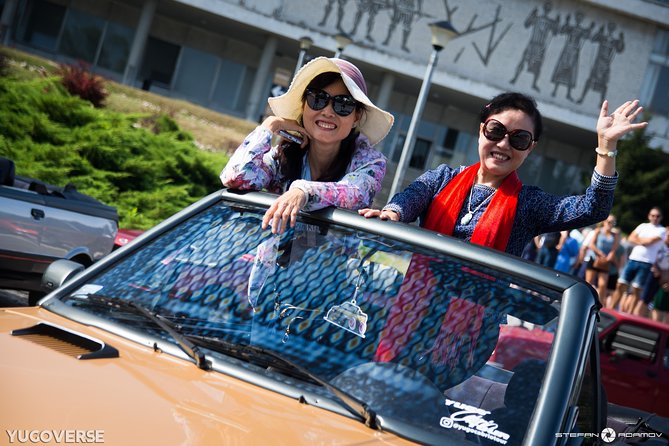
The Museum of Yugoslavia is the longest stop, with about 40 minutes and admission included. This is the tour’s main indoor visit and the place where the car story connects most clearly with Tito and the former country.
The museum began in 1962 as a collection of gifts given to Josip Broz Tito by people in Yugoslavia and by world leaders. After Tito’s death, the institution was combined with several related sites, including the House of Flowers, his residence, the Pool House, the Hunting Lodge, and the Old Museum. Its collections contain more than 200,000 objects organized into 20 groups.
That background tells you what kind of museum to expect. It is not simply a standard chronological account of Yugoslavia. It grew around Tito’s public and private legacy, and its collections reflect the way leaders, citizens, and foreign governments represented their relationship with him.
The museum helps explain why the Yugo can carry such a strong emotional charge. Cars are everyday objects, but they can also express national industry and state policy. A discussion of the Yugo becomes more meaningful when you see it beside the gifts, images, and official symbols connected with Tito’s rule.
Forty minutes is enough for an introduction, but not enough to see every object carefully. If museums are central to your interests, you may want to return on your own. The tour gives you context and access, but it is not a full-day museum visit.
The House of Flowers is part of the wider museum complex, but the supplied details do not clearly state which buildings or rooms you enter during this tour. Ask your guide what is included on your date rather than assuming the full complex is covered.
Snacks, soda, pickup, and the practical details
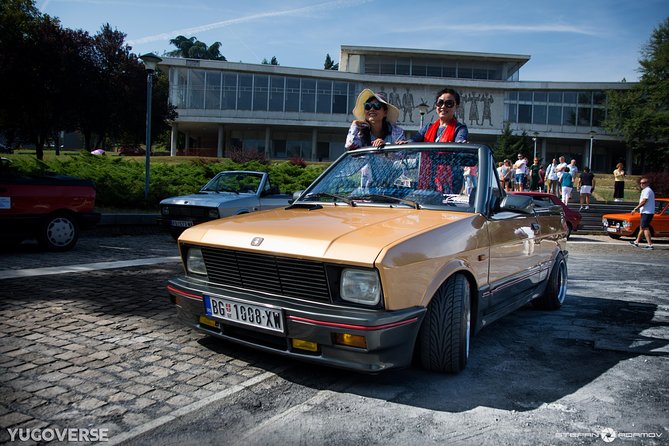
Snacks and soda are provided during the tour. That is a small feature, but it matters on a two to three-hour outing with several stops. You will not need to plan a café break in the middle of the route.
Pickup can be requested, while the listed starting point is Dragoslava Jovanovića 14 in Belgrade. The tour ends at a different location, so check the final drop-off details before making plans afterward. Since the route crosses several parts of the city, the changing end point may be useful, but it is worth knowing in advance.
The tour operates daily within the stated 9 a.m. to 9 p.m. opening window. Confirmation is sent within 48 hours of booking, subject to availability. Service animals are allowed, and the tour is near public transportation. The information says most people can participate, though no detailed vehicle-access information is provided.
The experience requires good weather and a minimum number of participants. If poor weather or low enrollment cancels the tour, you are offered another date or experience, or a full refund. You can cancel for a full refund up to 24 hours before the start time. Inside that 24-hour window, refunds and changes are not accepted.
Is $144 a fair price for this Belgrade tour?
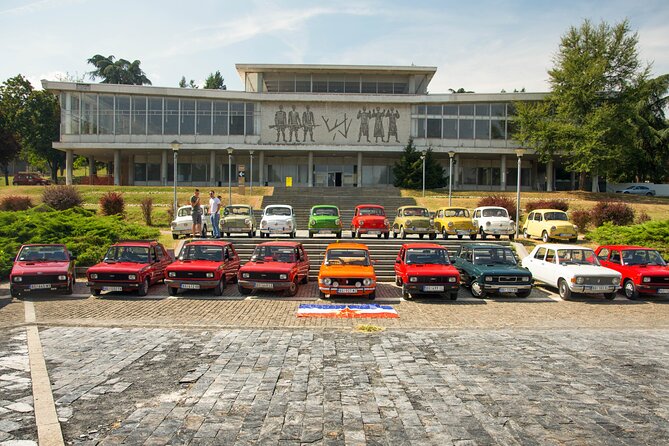
At $144, this is not a budget sightseeing ride. Its value depends heavily on group size and your interest in the subject.
For a private group sharing the cost, the price includes the guide, the vintage car experience, museum admission, snacks, soda, and the convenience of visiting several sites in one outing. You also avoid paying fees at each stop. That can make the price reasonable for a couple, family, or small group that wants a focused introduction to Yugoslav history and design.
For one person, or for someone mainly seeking a quick city orientation, the cost is harder to justify. Many of the outdoor stops are free, and the museum visit is the only clearly paid attraction. You are paying for the specialist theme, private transport, guide time, and the character of the car, not simply for entry tickets.
I would choose this over a standard sightseeing bus if you have already seen Belgrade’s basic highlights or if you are curious about Tito, socialist architecture, and the Yugo. I would skip it if your main goal is a low-cost overview of the old town, Kalemegdan, or the riverside.
Who will get the most from the experience?
This tour suits you best if you like unusual transport, 20th-century politics, brutalist architecture, or museums built around real objects and personalities. It is also a good choice for anyone who wants a private outing rather than a large group schedule.
Families with older children may find the Yugo angle more memorable than a standard political tour. Architecture fans will appreciate Genex Tower and Palata Srbije. People with an interest in Cold War history will get the most from the connection between Friendship Park, the Non-Aligned Movement, Tito, and Yugoslav industry.
You should think twice if you need a highly structured museum tour, a long list of interior visits, or a guaranteed particular guide. The tour is strongest as a guided story told across the city, not as a series of lengthy building visits.
Should you book this vintage car tour?
Book it if you want to see Belgrade through the story of Yugoslavia rather than through a checklist of famous sights. The combination of a vintage Yugo, Tito’s museum, Friendship Park, Palata Srbije, and Genex Tower is highly specific, and that focus is the reason to choose it.
The best value comes when two or more people share the private price and already have an interest in cars, politics, or modernist design. Ask about pickup, the ending location, the guide for your date, and which parts of the Museum of Yugoslavia are included. If those details fit your plans, this is a personable and memorable way to understand a complicated part of Belgrade.
FAQ
How long does the Tito and History Vintage Car Tour last?
The tour lasts approximately two to three hours. The listed stops include about 15 minutes at the National Assembly, 20 minutes at Friendship Park, 20 minutes at Palata Srbije, and 40 minutes at the Museum of Yugoslavia. Time at Genex Tower is not specified.
Is hotel pickup available?
Pickup can be requested. The listed meeting point is Dragoslava Jovanovića 14 in Belgrade, and the activity ends at a different location.
Is this a private tour?
Yes. Only your group participates in the activity.
What is included in the price?
The tour includes the guide, the vintage car experience, snacks, soda, and admission to the Museum of Yugoslavia. The supplied information also states that all fees are covered, so you do not need to pay on the spot.
Can I cancel for a full refund?
Yes. You can cancel at least 24 hours before the start time for a full refund. Cancellations or changes made less than 24 hours before the start time are not accepted and are not refunded.
What happens if the weather is poor?
The experience requires good weather. If it is canceled because of poor weather, you are offered a different date or experience, or a full refund.
Just added in Belgrade
- Belgrade Layover Private tour + E-Scooter Sighteeing★ 5.0 · 6 reviews
- Belgrade Insight Private Tour – For Those Who Seek Answers★ 5.0 · 6 reviews
- Belgrade Private Driving & Walking Tour★ 5.0 · 4 reviews
- Belgrade Fashion and Design Tour – Discover Local Designers★ 5.0 · 4 reviews
- 4-Hour Belgrade Private Grand City Walking Tour★ 5.0 · 8 reviews
- Belgrade Local Craft Beer Tasting Tour★ 5.0 · 8 reviews
- Belgrade Chuggalong – Pub Crawl★ 4.0 · 8 reviews
- Ada Lake Tour★ 5.0 · 7 reviews
Communist & Yugoslav History Tours, compared.
Belgrade Underground Tour w/ Sparkling Wine Along the River
Read our review →
Browse the lists this tour appears in