
Reviewed · COMMUNIST & YUGOSLAV HISTORY TOURS
Communist Tour in Belgrade
Belgrade’s Communist Tour is really a tour of Yugoslavia’s rise and collapse, told through city squares, government buildings, damaged architecture, and Tito’s final resting place. You begin in the center and finish at the Museum of Yugoslavia, with the trolleybus ride helping connect the two parts of the city.
I like the way the route pairs political ideas with physical places, especially the NATO-damaged General Staff building and the Museum of Yugoslavia. I also like the small group limit of 15 and the fact that guides such as Stefan, Michael, and Milan bring different strengths, from careful historical explanation to practical knowledge of Belgrade’s transit system.
The main consideration is pace. Three hours covers a large subject, and several central stops last only 15 minutes. If you want to explore the museum slowly, you may need to return on your own after the tour.
Key points to know before booking
- Tito and Yugoslavia are the central themes: Expect discussion of the Youth Relay Baton, the Non-Aligned movement, socialist rule, and Tito’s public image.
- The route moves from central Belgrade to Dedinje: You walk between downtown landmarks, then take a trolleybus to the Museum of Yugoslavia.
- General Staff adds a powerful visual stop: The bomb-damaged Ministry of Defence building remains a major reminder of the 1999 NATO bombing.
- Museum entry and the trolleybus fare are included: The $24.03 price covers the two costs that are built into the route.
- The tour is conducted in English: Past guides include Stefan, Michael, and Milan, all praised for clear and balanced explanations.
- The group is limited to 15 people: That is a useful size for asking questions during a politically sensitive subject.
Why this tour matters in Belgrade
Belgrade’s Communist period cannot be understood by looking only at statues or grand public buildings. The story runs through the Kingdom of Yugoslavia, Tito’s socialist federation, the break-up of the country, the wars of the 1990s, the NATO bombing in 1999, and the democratic changes that followed.
This tour gives you a useful framework for those events. You are not simply shown a former parliament or an old cinema. You are told how each place fits into the wider story of Yugoslavia and modern Serbia.
That matters because the subject is complicated. Yugoslavia was socialist, but it was not part of the Soviet Union after Tito’s break with Stalin. It led the Non-Aligned movement, built its own political identity, and promoted Tito as an international figure. Later, the country fractured through conflict, leaving Serbia with difficult questions about memory, responsibility, and national identity.
A good guide needs to handle that without turning the tour into either propaganda or a political argument. Stefan is praised for fact-based explanations and for giving book and documentary suggestions. Milan is noted for an objective presentation of events from the distant past through recent decades. Michael brings strong interest in the subject and can also help explain how the transit system works.
More of the recent past in Belgrade:
- Belgrade Underground Tour w/ Sparkling Wine Along the River
★ 5.0 · 151 reviews - Belgrade War Island Kayak Tour
★ 5.0 · 101 reviews - Red Belgrade Communist Tour
★ 5.0 · 78 reviews
Trg Republike: start with Tito, youth, and political change
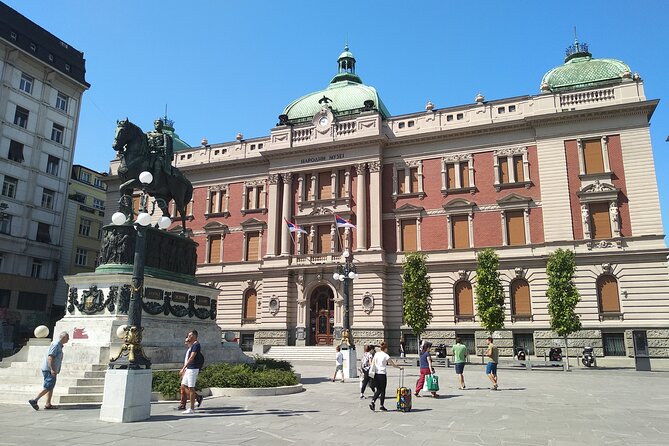
The tour begins at Trg Republike, or Republic Square, one of central Belgrade’s main gathering places. It is a practical starting point because the square sits at the heart of the city and gives the guide room to place modern Serbian history in context.
Expect the opening discussion to cover several large themes:
- Josip Broz Tito and the political system he led
- The Youth Relay Baton, a major symbol of loyalty to Tito
- The Non-Aligned movement
- The conflicts of the 1990s
- The NATO bombing of Serbia and Montenegro in 1999
- Democratic changes at the start of the third millennium
The stop lasts about 15 minutes, so this is an introduction rather than a full lecture. I like that the tour begins with ideas before moving to buildings. You learn what to watch for as you continue through the city.
The square itself is also useful for orientation. If you arrive early, you can easily identify the starting point at Trg Republike in downtown Belgrade. The tour begins at 3 p.m., so the opening portion takes place in the afternoon.
Mts Dvorana and the look of socialist Belgrade
The next stop is mts Dvorana, formerly known as Dom Sindikata, or Trade Union Hall. The building was designed by Branko Petričić, and construction began in 1947. Its style is described as Socialist realism, a form of architecture tied to the political and cultural priorities of socialist states.
You get about 15 minutes here. The value of this stop is visual: the building helps you see how the new Yugoslav state presented itself in the early postwar years. It was not only building offices and housing. It was also creating public places for organized social, political, and cultural life.
The short visit means you should not expect an interior tour or a long architectural analysis. Instead, listen for the connection between the building’s form and the early socialist period. This is one of several places where the guide turns ordinary city streets into evidence of political change.
The National Assembly and the machinery of government
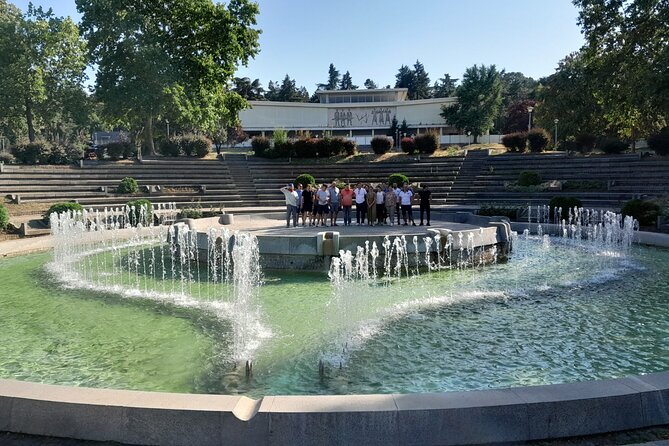
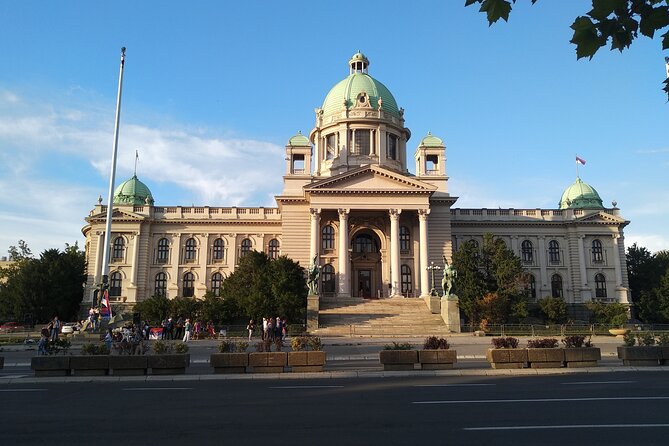
From there, the route continues to the House of the National Assembly of the Republic of Serbia on Nikola Pašić Square. This landmark served as the parliament of Yugoslavia and later the parliament of Serbia and Montenegro between its completion in 1936 and 2006.
That timeline makes the building especially useful for understanding political succession. It predates socialist Yugoslavia, then continued to serve as a seat of government through several different state arrangements. Its walls connect the Kingdom of Yugoslavia, socialist Yugoslavia, Serbia and Montenegro, and the modern Republic of Serbia.
The stop lasts around 15 minutes and admission is free. As with the other downtown sites, the tour is about explanation from outside rather than a formal interior visit. You’ll get the most from it if you pay attention to the guide’s account of how the same institution changed meaning under different governments.
Same city, a different kind of afternoon:
- Northern Serbia: Sremski Karlovci and Novi Sad Full-Day Tour from Belgrade
★ 5.0 · 425 reviews - Day Trip from Belgrade: Gems of Eastern Serbia
★ 5.0 · 424 reviews - Belgrade Nightlife Bar Pub Club Crawl with Drinks
★ 5.0 · 277 reviews - Taxi to/from Belgrade Airport to/from Belgrade City Center
★ 5.0 · 241 reviews
Kneza Miloša Street and the diplomatic heart of the city
Kneza Miloša Street receives about 20 minutes, making it the longest downtown stop. The street was once the city’s main korzo, or promenade. Today it is a major traffic route lined with important national institutions and more embassies than any other street in Belgrade.
This stop helps shift the focus from individual buildings to the city as a whole. A street can reveal how Belgrade changed from a social promenade into a route for government, diplomacy, and daily traffic.
I appreciate the longer time here because it allows the guide to explain how political power is spread across the city. The street is not presented as a museum object. It remains a working part of Belgrade, which makes the history feel connected to present-day life.
The practical drawback is that this is an urban walking tour, so traffic and the ordinary noise of the street are part of the setting. You are not touring a quiet historical site. You are moving through a functioning capital.
Generalštab: the most striking stop on the route
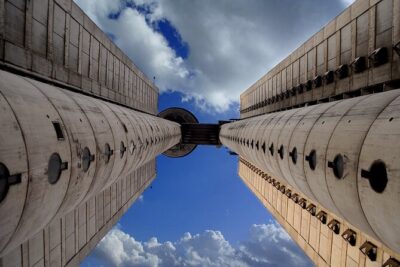
The Generalštab buildings, also known as the Yugoslav General Staff, are likely to be the most memorable exterior stop. The complex was formerly occupied by Yugoslavia’s Ministry of Defence, the government department responsible for military defense.
It is also considered a major example of postwar architecture. The buildings were heavily damaged during the NATO bombing of Yugoslavia in 1999, and the ruined sections remain a stark part of Belgrade’s cityscape.
This stop carries several layers at once. Architecturally, it represents postwar Yugoslavia’s confidence and state power. Politically, it points to the final decade of Yugoslavia and the wars that followed its collapse. Personally, it can be a difficult place because the damage is not an abstract image in a textbook. It is part of the city you are standing in.
The tour allows about 15 minutes here. That is enough for a clear explanation and a look at the site, but not enough for a long discussion of the bombing, its causes, or its aftermath. If this subject matters greatly to you, take notes and ask questions while the group is still together.
The building also gives the tour emotional weight without needing dramatic presentation. A balanced guide can explain the political background while allowing the damaged structure to speak for itself.
The trolleybus ride connects two Belgrades
After Generalštab, the group takes a trolleybus to the Museum of Yugoslavia. The ride takes about 15 minutes, and the ticket is included.
This is a small but useful part of the experience. You are not placed in a private vehicle and moved from one sight to another. You use public transportation, just as people do in Belgrade. The ride also creates a natural pause after the central walking route.
Michael is specifically praised for understanding the transit system, which can be helpful here. The trolleybus segment is not just a transfer. It shows how the tour moves from downtown institutions to the Dedinje area, where the Museum of Yugoslavia is located.
Allow a little flexibility in your expectations. Public transportation can take longer than a direct car ride, and the overall tour is listed as approximately three hours. The trolleybus journey is included, but the schedule is still part of city life rather than a private timetable.
Museum of Yugoslavia and the House of Flowers
The final stop is the Museum of Yugoslavia, where you spend about an hour. Admission is included, and this is the only paid attraction built into the route.
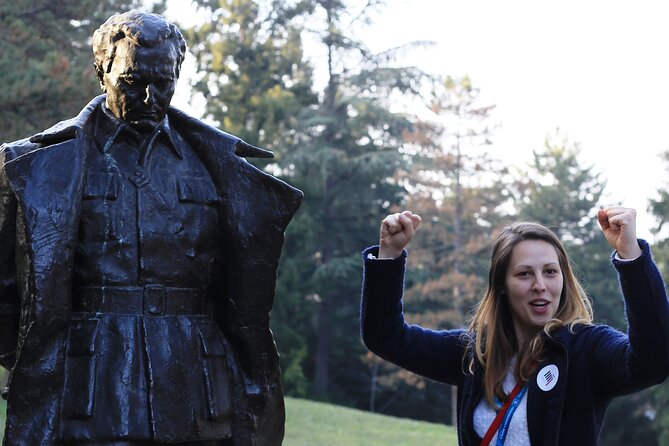
The museum covers the Kingdom of Yugoslavia, socialist Yugoslavia, and the life of Josip Broz Tito. One of its buildings, the House of Flowers, contains Tito’s grave. This gives the tour a strong ending because the earlier discussion of Tito’s political image becomes tied to a real place of remembrance.
The museum receives about 120,000 visitors a year and is described as the most visited museum in Serbia. You should still keep your expectations realistic. One hour lets you get a clear introduction, but it is not enough to study every display or period in detail.
I like the structure of ending here. The downtown stops show how the state expressed itself in public buildings and streets. The museum then provides objects, documents, and displays that give the story more substance. The House of Flowers adds a personal and symbolic dimension to Tito’s story.
If you already have a strong interest in Yugoslavia, you may want more time than the schedule allows. The practical answer is simple: use the guided hour to understand the museum’s main themes, then consider returning independently if you want a slower visit.
Is $24.03 good value?
At $24.03 per person, this tour offers solid value for a three-hour experience. The price includes an English-speaking guide, admission to the Museum of Yugoslavia, and the trolleybus ticket. The downtown stops have no admission charge, but the guide’s interpretation is the main product here.
You are paying for structure and context. Without a guide, you could see Republic Square, Dom Sindikata, the Assembly building, Kneza Miloša Street, and Generalštab, but you would not automatically understand how they connect. You would also miss the reason for ending at the Museum of Yugoslavia and the House of Flowers.
The small group limit helps protect that value. With no more than 15 people, you have a better chance of hearing the explanation and asking a question. Group discounts are available, so the price may work particularly well if you are booking for several people.
The tour is often booked about 16 days ahead, which suggests you should not leave it until the last minute if your Belgrade schedule is fixed. Confirmation is provided at booking, and the activity is near public transportation.
Free cancellation is available if you cancel at least 24 hours before the start time. A cancellation inside that window is not refundable, and the tour requires a minimum number of participants. If that minimum is not reached, you are offered another date or experience, or a full refund.
Who will get the most from this experience?
I would choose this tour if you know little about Yugoslavia and want a clear starting point. The guides are expected to explain difficult subjects in English, and the route gives you both a city walk and a museum visit.
It also suits you if you are interested in:
- Tito and socialist Yugoslavia
- The Non-Aligned movement
- The political changes of the 1990s
- NATO’s 1999 bombing of Serbia and Montenegro
- Belgrade’s postwar architecture
- Public history and contested memory
The tour may be less suitable if you want a long museum visit, an interior tour of government buildings, or a narrow focus on architecture. Several stops are brief, and the subject reaches from the 1940s to the early 2000s in one afternoon.
For a first visit to Belgrade, I like the way this tour gives you a framework for later sightseeing. Once you understand the political background, the city’s monuments and damaged buildings make more sense.
Should you book the Communist Tour in Belgrade?
Book it if you want more than a quick look at Tito-related sights. The strongest parts are the balanced English explanations, the small group size, the damaged General Staff building, and the final hour at the Museum of Yugoslavia.
The best guides appear to be those who can keep the facts clear without flattening the arguments. Stefan is a strong choice for historical detail and follow-up reading suggestions. Milan is a good fit if you value an objective account of both older and recent events. Michael may be especially useful if you appreciate practical help with the trolleybus and city transport.
Skip it if you prefer to explore museums at your own pace or if three hours feels too compressed for such a large subject. For most visitors interested in modern Serbia, though, $24.03 is a sensible price for a guided route that connects Belgrade’s streets, politics, architecture, and memory.
FAQ
Where does the Communist Tour in Belgrade begin?
The tour begins at Trg Republike in Belgrade, Serbia.
Where does the tour end?
The tour ends in front of the Museum of Yugoslavia at Mihaila Mike Jankovića 6, Belgrade 11000.
What time does the tour start?
The scheduled start time is 3 p.m.
How long does the tour last?
The tour lasts approximately three hours.
Is the tour offered in English?
Yes. The tour is offered in English.
What is included in the price?
The price includes entrance to the Museum of Yugoslavia, a trolleybus ticket, and a professional tour guide.
Is the Museum of Yugoslavia included?
Yes. Museum admission is included, with about one hour scheduled at the museum.
Does the tour use public transportation?
Yes. The group takes a trolleybus from the Generalštab building to the Museum of Yugoslavia. The ride takes about 15 minutes, and the ticket is included.
How large is the group?
The group has a maximum of 15 people.
Can I cancel for a full refund?
Yes, if you cancel at least 24 hours before the experience starts. Cancellations made less than 24 hours before the start time are not refunded.
Just added in Belgrade
- Belgrade Layover Private tour + E-Scooter Sighteeing★ 5.0 · 6 reviews
- Belgrade Insight Private Tour – For Those Who Seek Answers★ 5.0 · 6 reviews
- Belgrade Private Driving & Walking Tour★ 5.0 · 4 reviews
- Belgrade Fashion and Design Tour – Discover Local Designers★ 5.0 · 4 reviews
- 4-Hour Belgrade Private Grand City Walking Tour★ 5.0 · 8 reviews
- Belgrade Local Craft Beer Tasting Tour★ 5.0 · 8 reviews
- Belgrade Chuggalong – Pub Crawl★ 4.0 · 8 reviews
- Ada Lake Tour★ 5.0 · 7 reviews
Communist & Yugoslav History Tours, compared.
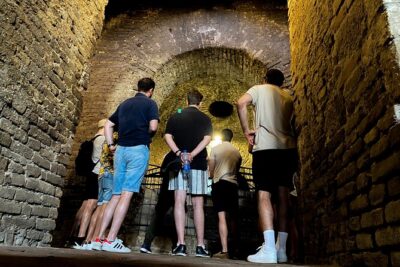
Belgrade Underground Tour w/ Sparkling Wine Along the River
Read our review →

Browse the lists this tour appears in