
Reviewed · NOVI SAD & SREMSKI KARLOVCI TOURS
3 Hour Private Walking Tour in Novi Sad City
Novi Sad’s beauty is easy to spot. The harder part is understanding why a Catholic church, an Orthodox cathedral, a synagogue, Austro-Hungarian buildings, Serbian cultural institutions, and a fortress across the Danube all belong in the same city story. This private walk, led by Vadim, links those pieces in a compact route through the center.
I like the private format, which lets you ask questions and adjust the conversation to your interests. I also like the wide historical range, from the city’s multinational roots to the Novi Sad massacre of 1942 and the founding of Socialist Yugoslavia.
The main consideration is transport: you must get to Novi Sad yourself from Belgrade. The walk is also listed as about 2 hours 30 minutes, despite the three-hour title, and many stops are brief exterior visits.
Key points to know before you book
- Start in Freedom Square: The Name of Mary Church and Novi Sad City Hall provide an immediate introduction to the city’s Catholic, Serbian, and Austro-Hungarian connections.
- A private walk for up to four people: The $57.82 group price becomes especially good value when shared by three or four people.
- Vadim brings history and art together: His approach includes architecture, literature, religion, wartime events, and national identity.
- Coffee or tea is included: Dunavska Street provides a short break at a non-smoking café.
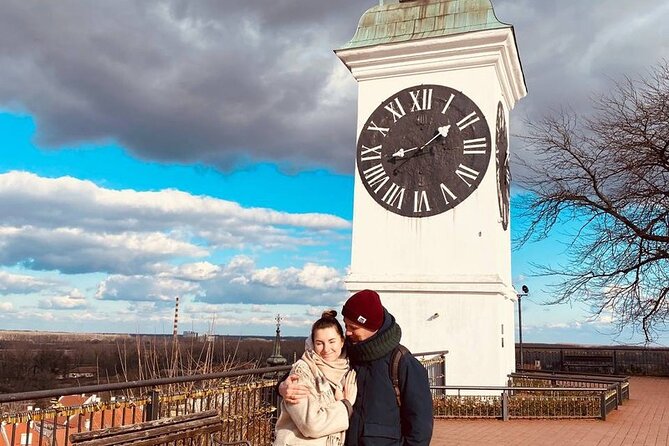
- Petrovaradin Fortress is viewed from the city side: You learn its role in Novi Sad history, but this tour does not take you inside the fortress.
- Transport is your responsibility: Bus or train connections from Belgrade are easy to use, but the cost and planning are separate from the tour.
Freedom Square gives you the city in one glance
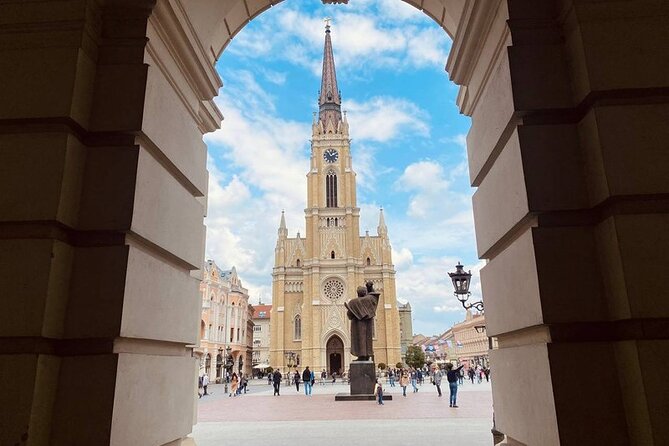
Meet at Trg slobode, or Freedom Square, the natural starting point for understanding Novi Sad. The Name of Mary Church faces the square, its Catholic identity offering an early clue that this is not simply another Serbian Orthodox city.
You can look inside the church if it is open and the visit fits the timing. The stop itself is short, about five minutes, so this is not a church tour with a long interior visit. It is a quick orientation that helps you notice how religious traditions share the same urban center.
Nearby, Novi Sad City Hall provides the next piece. The discussion includes the city’s first Serbian mayor and the monument made by a noted Croatian sculptor. That combination is useful because it shows how Novi Sad developed as a multinational town, shaped by Serbian, Croatian, Hungarian, Jewish, Catholic, Orthodox, and other communities.
You will not spend long inside either building. The value is in having Vadim point out the political and cultural meaning behind what you are seeing, rather than simply taking a photograph and moving on.
Other trips north out of Belgrade:
- Northern Serbia: Sremski Karlovci and Novi Sad Full-Day Tour from Belgrade
★ 5.0 · 425 reviews - From Belgrade: Novi Sad and Sremski Karlovci Tour
★ 4.5 · 101 reviews - Private transfer from Belgrade or Belgrade Airport to Novi Sad
★ 5.0 · 38 reviews
Zmaj Jovina Street turns architecture into a story
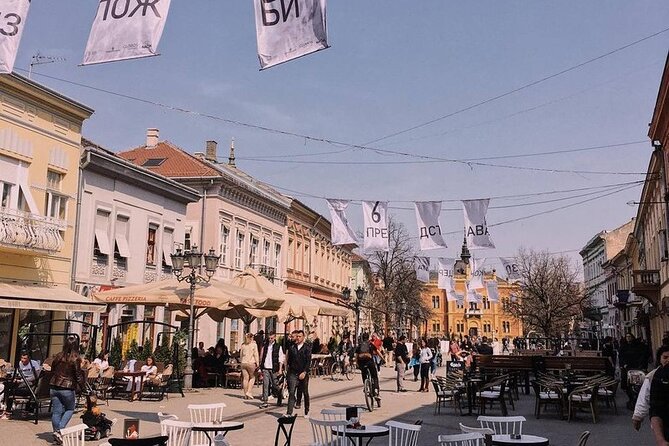
The walk continues along Zmaj Jovina, Novi Sad’s main pedestrian street. It is named for Jovan Jovanović Zmaj, one of Serbia’s best-known poets, and the tour includes a stop at his monument.
This section should appeal to anyone who likes city details more than grand monuments alone. The route includes courtyards and a notable Bauhaus-style building, so keep your eyes up and also look through entrances and side passages. Novi Sad often rewards that habit.
A private guide can make this kind of street more interesting because the important details are not always at eye level. The courtyards, facades, and building styles reveal how commercial and residential life developed in the old center. You are not just told that the city is attractive. You are given reasons for its particular appearance.
The next stretch follows Svetozara Miletića Street. Here the tone becomes darker. You will see the mansion connected with mass executions during the Second World War, then move into one of Novi Sad’s most expensive areas, with several notable buildings along the way.
One highlight is an old Serbian bank building topped by a monument to Mercury. It is a small but memorable detail, linking commerce, architecture, and the ambitions of a growing city. The contrast between elegant facades and wartime memory gives this part of the walk more weight than a simple architecture stroll.
Grčkoškolska Street and Matica Srpska explain Novi Sad’s cultural role
Grčkoškolska Street once housed some of the city’s wealthiest residents. The stop includes a famous balcony belonging to a merchant who built the building now associated with Matica Srpska, Serbia’s leading cultural institution.
This is where the tour moves from city history into national culture. Matica Srpska is not just another attractive building. Its library and wider work connect Novi Sad with Serbian literature, scholarship, and the preservation of national culture.
At the Matica Srpska Library, you will spend about ten minutes discussing that role. The street also comes with a surprising personal connection: Albert Einstein and his Serbian wife spent several months here. The point is not to turn the stop into a celebrity anecdote, but to show how this small area has been tied to wider European intellectual life.
Most stops are listed as free, and this tour focuses on exterior views rather than paid entry. That keeps the price low, but it also means you should not expect extended time inside the library or other institutions.
Orthodox and Catholic Novi Sad meet at St. George’s Church
Saborna crkva, the main Orthodox church of the city, is dedicated to St. George. Here you discuss how the Austro-Hungarian Empire influenced architecture in northern Serbia and compare Orthodox and Catholic traditions.
An optional look inside the church can add another layer to the discussion. Still, interior access is not presented as guaranteed or as a full guided visit, so treat it as a possibility rather than the central feature.
The comparison with the Name of Mary Church makes sense at this point. You have already seen a major Catholic landmark, and now you can consider how two religious traditions shaped the same urban environment. For many people, this is more useful than a general lecture on Balkan history because the buildings give you something concrete to examine.
From the Orthodox church, the route leads to the Bishop’s Palace. Its exterior uses a traditional Serbian architectural style with links to the southern parts of the country. The building looks different from the Austro-Hungarian-influenced structures nearby, which makes the contrast easy to understand.
The walk then includes the oldest Turkish well, dating to 1720, and a mural depicting important figures from the city’s past. These details help connect Novi Sad’s Serbian, Ottoman, and Central European influences without reducing the city to a single national story.
Other walks around Belgrade:
- Belgrade: 3-Hour Small Group Walking Tour
★ 5.0 · 180 reviews - Half-Day Sightseeing and Walking Tour of Belgrade City
★ 5.0 · 37 reviews - Belgrade City Walk, Gathering and Sightseeing
★ 5.0 · 19 reviews - Belgrade Private Walking Tour with a Local
★ 5.0 · 19 reviews
The Fish Market adds a local everyday stop
At the Fish Market, the tour pauses by the monument to Peter I of Serbia and discusses his role in the country’s history. The market is also an active local gathering place, particularly when evening events take place there.
This stop breaks up the churches, palaces, and cultural buildings with a more ordinary part of city life. You get a sense of how the central area works as a place for residents, not only as a display of historic architecture.
The stop is about ten minutes, so do not expect a long market visit or a food-focused experience. Its purpose is to connect a national political figure with a place used by people in their daily routines.
Dunavska Street provides the tour’s needed pause
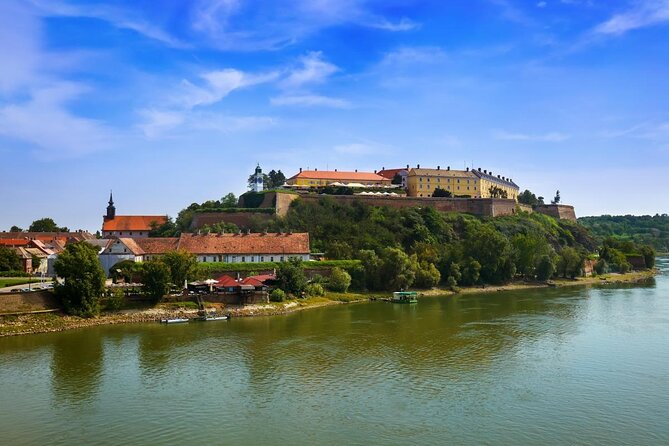
Dunavska Street is one of Novi Sad’s oldest streets and includes the planned coffee break. Coffee or tea is included, and the guide specifically uses a non-smoking café, a useful detail in a country where finding such a place can be difficult.
This short pause matters more than it might appear. A walking tour with many historical stops can become a stream of names and dates. Ten minutes to sit down gives you time to ask Vadim about something you have just seen or to decide what deserves another look later.
The break is brief, not a full meal stop. If you need lunch, plan that separately.
Museums and Danube Park widen the picture
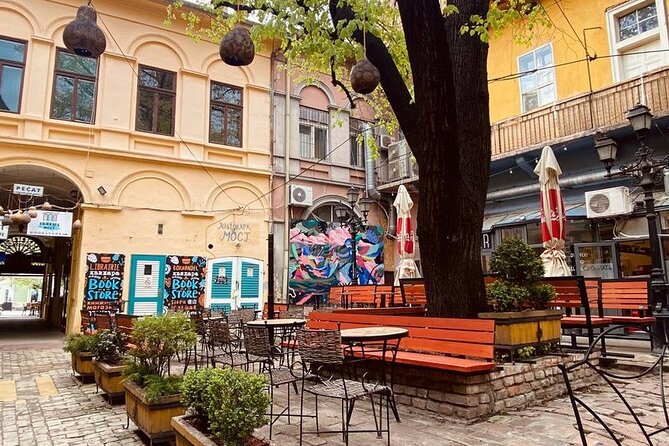
The route then reaches the city’s museum area. You will see the Museum of Novi Sad, the Museum of Vojvodina, and the Museum of Contemporary Art. The Museum of Novi Sad has a collection that includes European masters, while the Museum of Vojvodina is noted for archaeological displays and the Museum of Contemporary Art hosts temporary exhibitions.
The tour does not present these as extended museum visits. Instead, you get an introduction to the cultural institutions and their place in the city. If one catches your interest, you can return on your own, subject to opening hours and admission arrangements that are not included here.
Danube Park, founded at the end of the nineteenth century, adds greenery and breathing room to the route. It also helps you see how Novi Sad’s historic center is organized around public spaces, museums, and streets that invite walking.
Petrovaradin Fortress remains across the Danube
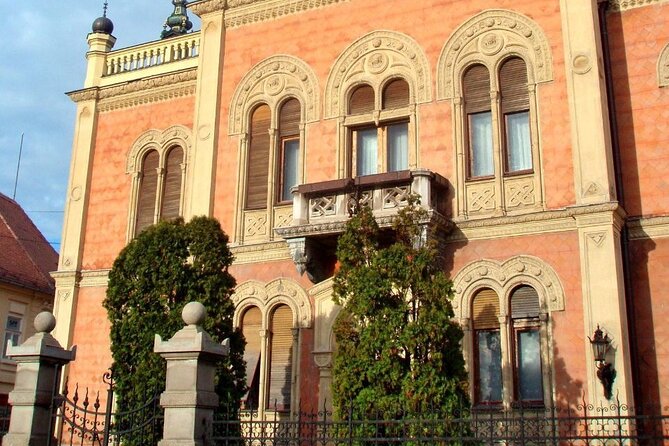
Petrovaradin Fortress is one of Novi Sad’s defining sights, but this experience views it from the opposite side of the Danube. You will learn about the fortress’s role in the city’s development and see its position across the river.
That distinction matters. If you want a fortress visit, underground passages, or extended time on the hill, this is not that tour. You get context and a clear view, but the walk does not include transportation to Petrovaradin or a visit inside the complex.
For a first introduction to Novi Sad, the viewpoint is useful because it places the city and fortress in the same frame. You can decide later if you want to return for a separate visit.
The Danube embankment confronts the city’s wartime past
The Monument to the Victims of Fascism on the Danube embankment is one of the most serious stops. It relates to the Novi Sad massacre of 1942, and the discussion covers the city’s wartime experience, Serbia’s role in the Second World War, and the founding of Socialist Yugoslavia.
Only about five minutes are assigned to the stop, which is short for such difficult material. The benefit is that the monument is not passed without explanation. The limitation is that anyone seeking a detailed study of the massacre or Yugoslav history will need more time elsewhere.
This is one reason the private format helps. You can ask for clarification or signal that you want more context, although the overall route still has to keep moving.
City Assembly and Matica Srpska Gallery show national ambition
The exterior of Novi Sad’s City Assembly is another architectural stop. The building is especially striking when you consider the decade in which it was built, and the discussion connects it to how the city operates and why northern Serbia matters to the country.
The Matica Srpska Gallery follows. It is described as Serbia’s most important gallery of Serbian art, with two additional galleries on the same square, one for modern art and one for contemporary art.
Again, you should expect an introduction rather than admission and a full gallery visit. If you like art, note these locations so you can return with more time. The tour gives you the cultural map, then leaves you free to choose where to spend a longer afternoon.
The synagogue and National Theatre close the walk
Novi Sad Synagogue is one of the city’s most important exterior sights. Designed by Lipot Baumhorn, a major local architect, it reflects the former importance of the Jewish community. It is no longer active as a synagogue and now functions as a concert hall.
This stop gives the tour another essential piece of Novi Sad’s identity. The city’s past cannot be understood through Serbian Orthodox and Catholic buildings alone. The synagogue makes the former Jewish presence visible in the street plan and architecture.
The final stop is the Serbian National Theatre. The conversation turns to the role of theatre in national identity, then gives you time for questions and recommendations. The tour finishes back at Freedom Square, where it began.
What the $57.82 group price really buys you
The price is $57.82 for a private group of up to four people. Split four ways, that is about $14.46 per person. For two people, it is about $28.91 each. Those figures make the tour particularly appealing for a small group that wants a private guide without paying a separate per-person rate.
You are paying for interpretation, not entry tickets. The route includes many free exterior stops, and the only stated refreshment is coffee or tea. Private transportation is not included, so the value depends partly on how easily you can reach Novi Sad.
From Belgrade, the city is easy to reach by bus or train, according to the tour information. You will need to arrange that connection yourself and arrive at Freedom Square. This keeps the walk cheaper, but it makes the experience less convenient than a door-to-door day trip.
The activity is usually booked about 28 days ahead. That does not guarantee availability, but it is a sensible reason to reserve early if your schedule is fixed.
Who will get the most from this walk
I would choose this tour if you want a compact introduction to Novi Sad that treats architecture, religion, literature, art, and political history as parts of one story. It suits couples, families, or friends who prefer their own guide and want room for questions.
It is also a good match if you are staying in Belgrade and want to make Novi Sad a self-directed day trip without paying for private transport. The tour begins and ends in the same central place, which simplifies the day once you arrive.
You may want something else if your main goal is Petrovaradin Fortress itself, long museum visits, shopping, food tasting, or a slow café crawl. You should also be comfortable walking for about 2.5 hours and standing at several stops. A moderate level of physical fitness is recommended.
Confirmation is provided when you book. Service animals are allowed, and the meeting point is near public transportation. Free cancellation is available until 24 hours before the start time. Poor weather can lead to a different date or a full refund, so keep the weather in mind when planning.
Should you book the Novi Sad private walk?
Book it if you want the city explained rather than merely photographed. The strongest feature is the way Vadim connects Novi Sad’s different communities and eras, with lively discussion of history and art and an adaptable approach to questions.
The clearest drawbacks are the missing transport, short stop times, and exterior focus. If those fit your plans, $57.82 for up to four people is a fair price for a thoughtful orientation to Novi Sad. Arrive ready to walk, keep the rest of your day flexible for any museum or fortress visits you want to make afterward, and use the private format to ask about the subjects that matter most to you.
FAQ
Where does the tour begin?
It begins at Trg slobode, or Freedom Square, in Novi Sad, Serbia.
Where does the tour finish?
The activity ends back at the meeting point in Freedom Square.
How long does the walking tour last?
The duration is approximately 2 hours and 30 minutes, although the experience title refers to three hours.
Is transportation from Belgrade included?
No. Private transportation is not included. You are expected to reach Novi Sad independently by bus, train, or another means.
How much does the tour cost?
The listed price is $57.82 per group, for up to four people.
Is this a private tour?
Yes. Only your group participates.
Is coffee included?
Yes. A coffee or tea stop is included during the walk.
Are museum admission tickets included?
The listed stops have no admission ticket cost, and the tour focuses mainly on exterior visits. Optional church interiors may be viewed, but extended museum entry is not included as part of the stated experience.
Can I see Petrovaradin Fortress?
You can see Petrovaradin Fortress from across the Danube and learn about its role in Novi Sad history. The walk does not include transportation to or admission inside the fortress.
What happens if I need to cancel?
You can receive a full refund if you cancel at least 24 hours before the experience start time. Cancellations or changes made less than 24 hours before the start are not refunded, and poor weather may result in a different date or a full refund.
More short tours in Belgrade
- 3-Hour Belgrade Zemun Neighborhood Tour
★ 5.0 · 8 reviews
Just added in Belgrade
- Private Half Day Serbia Tour Novi Sad and Petrovaradin Fortress★ 5.0 · 3 reviews
- Private Belgrade Street Art and Adventures Walking Tour★ 5.0 · 4 reviews
- From Belgrade:Uvac Nature Reserve Tour★ 5.0 · 4 reviews
- Private Wine Tasting by Party in Belgrade★ 5.0 · 3 reviews
- Urban & Alternative Belgrade tour★ 5.0 · 4 reviews
- Shooting Experience by Party in Belgrade★ 5.0 · 8 reviews
- Transportation from Belgrade or Belgrade Airport to Tara, Mokra Gora or Sagan 8★ 5.0 · 6 reviews
- Belgrade Bike Tour: Be a local in the hood of Belgrade!★ 5.0 · 5 reviews
Novi Sad & Sremski Karlovci Tours, compared.
Northern Serbia: Sremski Karlovci and Novi Sad Full-Day Tour from Belgrade
Read our review →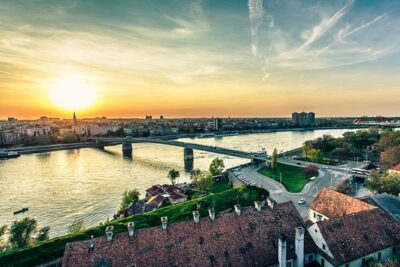
Private Day Tour to Fruska Gora Monasteries, Sremski Karlovci and Novi Sad
Read our review →
Private Novi Sad, Titanic wine tasting and Farmer’s House
Read our review →

Private Day Tour Discovering Hidden Gems of Novi Sad in Luxury
Read our review →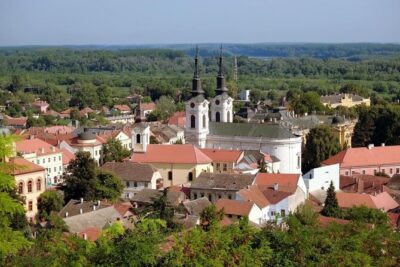
Northern Serbia: Sremski Karlovci, Petrovaradin Fort & Novi Sad
Read our review →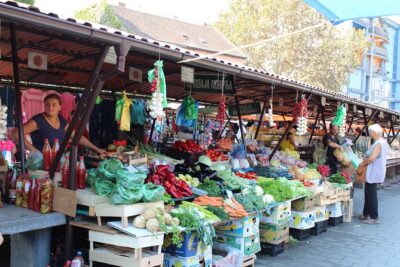
Novi Sad and Sremski Karlovci private tour with wine tasting
Read our review →Browse the lists this tour appears in